UK's No. 1 Cisco & Meraki Authorised Partner and Supplier


Choosing the right network equipment supplier is one of the most consequential IT decisions a UK business can make. Get it right and you have a reliable infrastructure partner for years. Get it wrong and you are left with mismatched hardware, expired licences, no warranty support, and an IT team spending its time firefighting rather than delivering value.


The UK market for business networking hardware is large and fragmented. Cisco Systems remains the dominant supplier by revenue in the UK enterprise networking market, with a particularly strong installed base across finance, government, and higher education. Yet the reseller landscape spans hundreds of companies, from large generalist distributors to specialist authorised partners, and the difference between them matters far more than most buyers realise.
Key insight: The supplier you choose determines more than the price you pay. It determines whether your licences are valid, whether your warranty is honoured, and whether you have access to manufacturer support when something goes wrong.
This guide covers the key equipment categories every business needs to understand, what to look for when evaluating suppliers, and why buying through an authorised partner is the single most important factor in a successful procurement.
What this guide covers:
Before evaluating suppliers, it is worth being clear on what you are actually buying. Business networking hardware falls into four primary categories, and a credible supplier should be able to advise on all of them as an integrated system rather than selling each component in isolation.
Switches are the backbone of your wired network. They connect desktops, servers, printers, IP phones, and wireless access points, and route traffic between them. For most businesses, the choice is between unmanaged switches (simple, cheap, no visibility) and managed or cloud-managed switches (more expensive, but essential for any network that needs segmentation, monitoring, or remote troubleshooting).
Two features are non-negotiable for modern deployments:
The router connects your office to the internet and, acting as a firewall, controls what traffic enters and leaves. The broadband router supplied by your ISP is designed for home use and is not appropriate for business environments. A business-grade gateway should provide:
Poor Wi-Fi is rarely a router problem. It is almost always an access point problem. Business-grade access points are ceiling-mounted, centrally managed, and positioned based on a proper site survey. For new installations, Wi-Fi 6E or Wi-Fi 7 are the recommended standards, both of which use the less congested 6 GHz band and provide meaningful headroom for the next five or more years.
Rule of thumb for access point density:
For cloud-managed platforms such as Cisco Meraki, hardware and software are sold separately. Every device requires an active licence subscription to function. Without a valid licence, the hardware stops passing traffic after a 30-day grace period. Most UK businesses purchase three or five-year terms to balance cost with flexibility. A five-year Enterprise licence for a Meraki access point typically costs 40 to 60 per cent of the hardware price; for switches, it is 30 to 50 per cent.
This is the most common procurement mistake: buying hardware without budgeting for licences, or purchasing licences from an unauthorised source that are later found to be invalid.
Cisco is not the dominant player in UK enterprise networking by accident. Its position reflects decades of investment in reliability, security, and support infrastructure that alternatives have yet to match at scale. For UK businesses in finance, healthcare, education, retail, and professional services, Cisco hardware is frequently the default choice for one straightforward reason: it works, and when it does not, there is a clear support path.
Cisco’s Catalyst switching range covers everything from small office access-layer deployments to large campus and data centre cores. The Catalyst 9200 series is the entry point for managed business switching, while the 9300 and 9500 series handle distribution and aggregation layers in larger environments. These are traditionally managed via CLI or Cisco’s on-premises management tools, making them the right choice for IT teams with networking expertise who want full control.
Cisco Meraki is a cloud-managed networking platform that covers switches (MS series), security appliances (MX series), and wireless access points (MR series), all controlled from a single web-based dashboard. Every device phones home to the Meraki cloud, where firmware updates, monitoring, and policy changes happen automatically.
The practical advantage for UK businesses is significant:
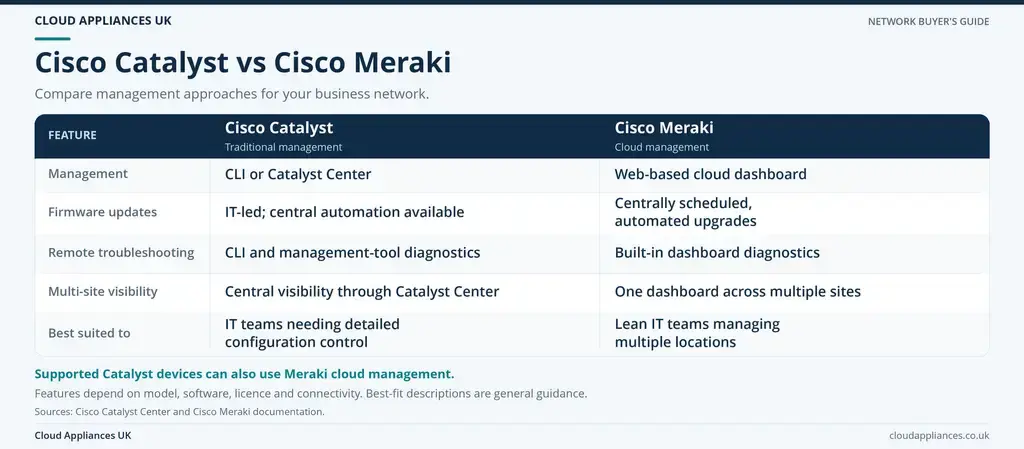
For most UK SMEs and mid-market businesses, Meraki is the more practical choice. The unified dashboard eliminates the need for separate management tools, and the cloud architecture means a small IT team can manage dozens of sites from a single pane of glass.
Every Meraki device requires a licence to operate. This is not optional. The licences are sold in one, three, five, seven, and ten-year terms through authorised partners. Buying from an unauthorised source risks receiving invalid or already-activated licences, which Cisco will not replace. This is why the choice of supplier matters as much as the choice of hardware.
Key takeaway: Meraki hardware purchased without a valid licence through an authorised channel is effectively a paperweight after 30 days. Always confirm your supplier’s authorised partner status before purchasing.


The UK has no shortage of companies willing to sell networking hardware. The question is not whether you can find a supplier; it is whether the supplier you find is the right one. These are the criteria that separate a genuine partner from a box-shifter.
This is the single most important criterion. An authorised Cisco or Cisco Meraki partner has been vetted by the manufacturer, trained on its products, and granted the ability to sell genuine, warranted hardware and valid licences. Buying outside this channel introduces several risks:
A good supplier does not just take your order. They help you specify the right equipment for your environment. This means asking questions about your user count, building layout, internet connection speed, number of sites, VPN requirements, and growth plans before recommending specific models or configurations.
Questions a strong supplier should ask before quoting:
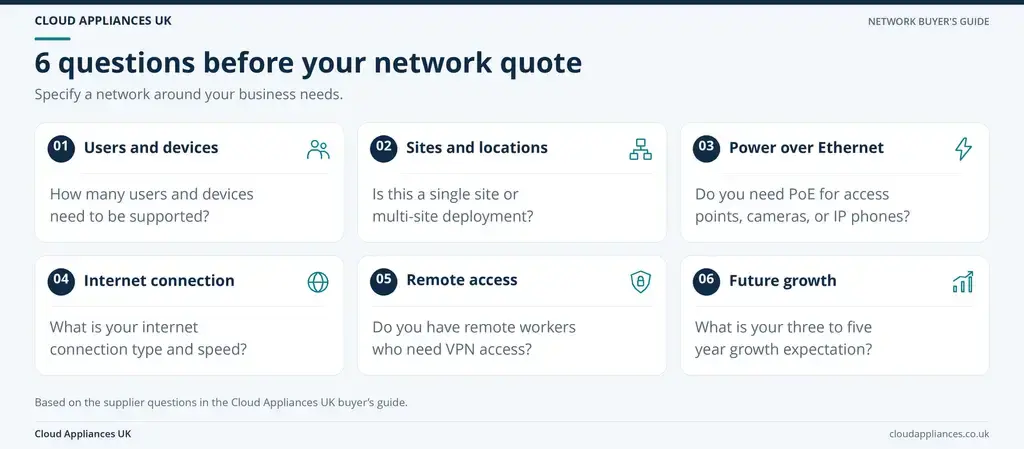
If a supplier quotes without asking any of these questions, treat that as a warning sign.
For UK businesses, practical logistics matter alongside technical capability. A credible supplier should offer:
| Capability | Why It Matters |
|---|---|
| Next-day delivery | Minimises downtime on urgent replacements or project deadlines |
| Online quoting | Allows IT managers to get accurate pricing without a sales call |
| Finance options | Spreads the capital cost of larger deployments |
| Post-sales technical support | Ensures you have someone to call when configuration questions arise |
| Licence renewal management | Proactive reminders before licences expire |
A supplier that only stocks a narrow range of products will push you towards what they have rather than what you need. Look for suppliers who can cover the full stack: switches, routers, firewalls, wireless access points, and the associated licences and software, ideally from a consistent platform so everything integrates cleanly.
The platform consistency argument is compelling. Mixing brands across your switching, routing, and wireless layers creates management overhead, complicates troubleshooting, and often results in features that do not interoperate as expected. Standardising on a single platform, such as Cisco Meraki across all three layers, is almost always the more cost-effective choice over a three to five year horizon.
Not every business has the same requirements, and the right supplier profile varies significantly depending on your size, IT capability, and the complexity of your networking needs.
For a small office, the core requirement is simplicity and reliability. You need equipment that is straightforward to set up, easy to manage without a dedicated network engineer, and backed by a supplier who can provide guidance when needed.
Recommended approach:
The key supplier requirement at this level is responsiveness and pre-sales guidance. Many small businesses do not have an in-house network specialist, so the supplier effectively fills that role.
At this scale, the stakes are higher and the technical decisions more complex. Multi-VLAN configurations, site-to-site VPN, redundant internet connections, and more granular security policies all become relevant. A 30 to 80 user Meraki deployment covering a security appliance, two 48-port PoE switches, six access points, and two cameras typically runs to £14,000 to £16,000 excluding VAT and installation.
What to prioritise in a supplier at this level:
For businesses with multiple sites, large user counts, or complex security requirements, the supplier relationship becomes more of a managed service than a transactional purchase. This is where the distinction between an authorised partner with technical depth and a generalist reseller becomes most pronounced.
Enterprise deployments typically involve:
At this level, the supplier should be capable of providing design, implementation, and ongoing management services, not just hardware fulfilment.
The networking hardware market has its share of pitfalls. These warning signs are worth checking before committing to a supplier.
The grey market problem is real. Cisco regularly publishes guidance on the risks of purchasing through unauthorised channels, and the consequences, including hardware that cannot be registered, licences that cannot be activated, and warranty claims that will be refused, fall entirely on the buyer.

Cloud Appliances is a UK-based Cisco and Cisco Meraki authorised partner, supplying switches, routers, firewalls, access points, and licences to businesses across the country. As an authorised partner, every product sold through Cloud Appliances carries valid manufacturer warranties and genuine licences registered through the official Cisco channel.
The practical advantages for buyers are straightforward:
For businesses evaluating their network infrastructure, whether that is a first-time deployment, a refresh of ageing hardware, or an expansion to additional sites, Cloud Appliances provides the combination of authorised partner credentials, technical depth, and commercial flexibility that the procurement deserves.
Ready to specify your network? Contact Cloud Appliances for a no-obligation quote or to speak with a technical specialist about your requirements.